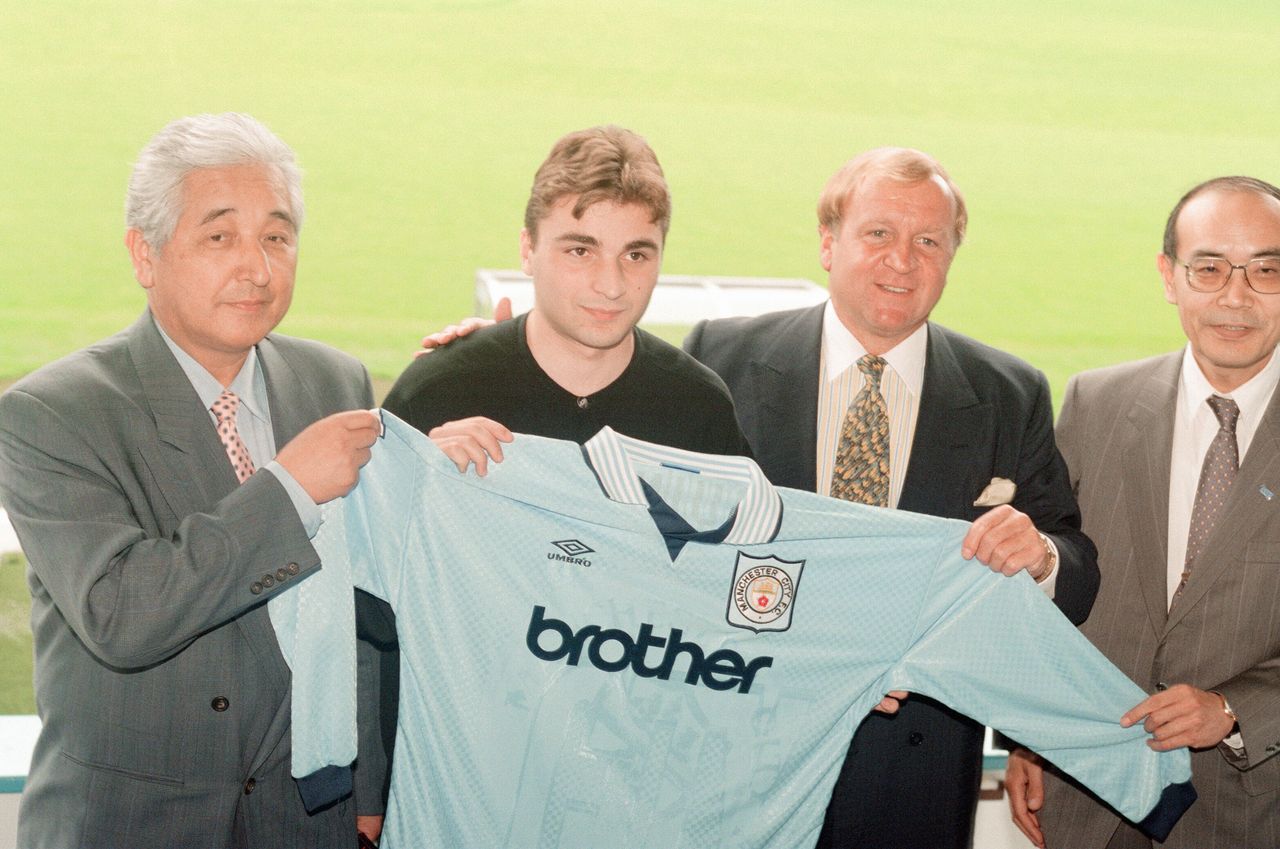
Georgi Kinkladze arrived at Manchester City in the summer of 1995. The Georgian attacking midfielder, then one of Europe’s most promising young talents, had just left Dinamo Tbilisi. His move coincided with the rise of the Premier League, which was beginning to attract the continent’s best players. City had even managed to pip AC Milan, a powerhouse of the era, to his signature.
The Georgian reflects on this pivotal decision as he looks back on his time at Maine Road.
“There was interest from Italian clubs, but Francis Lee [City’s chairman] was very determined,” Kinkladze tells FourFourTwo of his 1995 transfer. “He came to see me in person and convinced me that City was a club where I could be the star. I barely knew anything about Manchester, but I liked the idea of a new challenge in England.” The Georgian attacking midfielder quickly became a fan favorite at City, despite stepping into the unknown.
The early weeks revealed an English football landscape radically different from anything he had experienced. “From the moment I arrived, I realised the game was much faster and more direct,” he explains. “The weather and food were tough to handle, but the supporters took to me straight away. On my first day at Maine Road, they treated me like one of their own. That connection was immediate.” Alan Ball, then City’s manager, had spent the previous season at Southampton, where he had built his team around Matt Le Tissier, instructing his players to “just give the ball to Le Tissier.” Did Kinkladze receive the same treatment?
Alan Ball, the mentor who shaped his style
“Alan Ball played a key role in my development,” Kinkladze continues. “He loved technical players and wanted the team to play with flair, even if we struggled in the league. The 90s were a special time, and sometimes, I was targeted deliberately. If you tried to dribble, you’d get clattered without hesitation. Vinnie Jones and Wimbledon’s Crazy Gang were the specialists.” Ball, a former England international, was in charge at City at the time.
“But I’d grown up playing in the streets of Tbilisi, so I knew how to dodge a tackle. I always thought that if they couldn’t catch me, they couldn’t kick me.” A philosophy that allowed the Georgian to thrive despite the physical nature of the game. His early Premier League days also marked the arrival of many foreign talents, of which Kinkladze was a privileged witness.