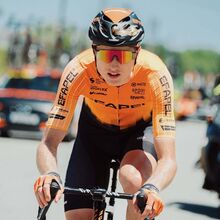
Keegan Swirbul, 30 years old and a member of the Portuguese Efapel team, has chosen to break a taboo in professional cycling. In a video posted this weekend on his YouTube channel KeggaGee (nearly 4,000 subscribers), the rider openly discussed the doping scandals that have rocked Portuguese cycling in recent years. His intervention, viewed over 16,000 times, comes just after he won the 2nd stage and the overall classification of the GP Douro Internacional.
José Neves, controversial return after a suspension
Among the cases cited by Swirbul is that of José Neves, who finished 4th in the Volta a Portugal this season after a four-year doping suspension. The North American does not mince his words: “He has the right to come back, that’s true, and he’s riding well. But it’s shocking that a team would hire him after the scandals that have devastated Portuguese cycling. Why take him back? You’re harming your young talents! They’re already so penalized by these cases that foreign teams systematically exclude them, simply because they’re Portuguese,” he fumes in the video. José Neves, suspended in 2022 while riding for W52-FC Porto, joined GI Group Holding this season. His return to the top level, marked by a 4th-place finish in the Volta’s general classification, has sparked incomprehension in the peloton.António Carvalho, the biological passport under scrutiny
Another case highlighted by Swirbul is that of António Carvalho, suspended for four years due to abnormalities in his biological passport. The North American rider paints a disturbing picture: “According to reports, he showed abnormalities as early as 2018, seven years before he retired. In the spring, he was heavy and struggling in the climbs, but by the time the Volta came around, he was down to almost no body fat… As if he were sick. I don’t know how many drugs he was injecting, but it was terrifying,” he says. Swirbul explains that Carvalho may have used corticosteroids, permitted under a Therapeutic Use Exemption (TUE). “These steroids make you lose weight quickly while preserving muscle mass. You can ask your doctor for them, then submit the request to the UCI or the national anti-doping agency. It’s done in two weeks. It destroys your health in the long run, but many abuse this practice, especially in Portugal, from what I’ve seen.”Fred Figueiredo, one year of competition despite a warning
Frederico Figueiredo’s case is no exception. According to Swirbul, the rider allegedly received notification in 2024 of irregularities in his biological passport but continued racing for another year. “In 2024, mid-season, he disappeared. We thought it was a crash. Then he came back for the Volta, rode in the winning team with Artem Nych, and a few weeks later won the GP JN. Later, we learned he had been notified a year earlier and that Anicolor had allowed him to compete despite the irregularities,” fumes the Efapel rider. “You’d have to be corrupt to let that happen…,” he asserts.
Swirbul also brings up Nuno Ribeiro, former sports director of W52-FC Porto, suspended for EPO and other substances during his career before returning as a manager. “That team had riders who, in the spring, couldn’t keep up in the mountains, yet came back in shape for the Volta. Something wasn’t right,” he sums up.
Finally, the North American questions Tadej Pogačar’s methods. Without directly accusing him, he doubts the Slovenian uses traditional methods like those of Lance Armstrong. “His level of consistency is too high for traditional doping. Maybe he’s using techniques still unknown, like gene or mitochondrial doping. If they’re pulling it off, hats off to them: they’re ahead of science and medicine,” he concludes, leaving the door open to doubts about the Slovenian’s performances.